This year, I visited Japan for the first time which was fantastic, in part because I had made the effort to learn some Japanese before the trip. To be clear, I absolutely can't speak Japanese or even hold a conversation. What I can do is interact in a couple of contexts and get some broad understanding of what is being said. That's it. And yet, it still felt incredibly meaningful so I want to share why that is the case, what my approach was, and what I would do differently.
Why try and learn only for a couple of weeks in Japan?
Unless you are doing this a year (or multiple) in advance, chances are that you will never reach a reasonable level of fluency before your trip... so why bother?
The first big reason is that Japanese people rarely speak English and when they do it's usually at a low level (no judgement here, I'm French). This means that compared to a lot of other countries, you being able to say a few things in the language will quickly be useful, especially if you decide to go outside of the tourist hotspots.
Second, having the ability to go through basic interactions in Japanese also helps with taking full advantage of the trip. Instead of having to go through translation apps, you get to have more meaningful interactions with people. On numerous occasions, I could see how glad they were that we could communicate even slightly with one another. Overall, the experience you get out of the trip is a lot richer and more interesting.
How I tried and learned Japanese
Here's what I did and what I would have done differently. But it's important to keep expectations reasonable: Coming from Western languages means you have to start from pretty much zero and learning anything is a struggle when vocabulary sounds like random sounds. You can still make progress and benefit from this work, but if you have a full-time job and a family life, don't expect to have fluid discussions after a couple of months.
Audiobooks can be fantastic
I tried two series of audiobooks: Pimsleur's Japanese language course and Michel Thomas' Japanese course.
- Michel Thomas: This course was fantastic and I can't recommend it enough. The strength of the Michel Thomas approach is that you quickly learn essential bricks of the language and use them to form increasingly complex sentences. It's very, very impressive how far you go in a couple of hours. This gives you both a good foundation but more importantly gives you the confidence necessary to keep learning.
The only downside is that you only learn the basics of Japanese. You do not really learn the vocabulary necessary to interact in restaurants, shops, or hotels. I wouldn't fault the course designers here; that wasn't the purpose of their audiobook.
If you wish to buy it, I would recommend using Libro.fm to get a DRM-free version. - Pimsleur: This approach is the absolute opposite. Whereas with the Michel Thomas method, you are told how the language works, this felt a lot more like Duolingo; you are told what a sentence means but rarely why it is structured the way it is. And then, it relies massively on repetition to get you to learn and pick up how things work.
Personally, I do not like this approach as it feels too tedious. Sometimes, explaining things directly makes a world of difference and reinforces your memory. Otherwise, especially with Japanese, it feels like you are just remembering random sounds, which is very challenging.
But if you don't mind the fact this approach is slower with lots of repetition (maybe you have some time daily on your commute), then this could work out for you.
For the Michel Thomas course, I generated numerous Anki cards to help keep this new knowledge in my mind until the trip. Otherwise, I felt there would have been the risk of the knowledge slipping before I could get to Japan. For this, I used AI to transcribe the course and then automatically generate the cards. It worked surprisingly well.
Learning the kanas... and kanjis?
Until that point, everything was oral, but there will come a point where you will need to read things. If you do not know, Japanese uses a mix of three writing systems: Hiragana, Katakana, and Kanji. The kanas are a syllabary similar in a way to our alphabet. But most words require kanjis, which are basically Chinese characters.
Basically there are around a hundred kanas... but there are thousands of kanjis.
Learning the kanas is surprisingly easy (the website Tofugu has amazing guides for Hiragana and Katakana with associated Anki decks). The short time investment is worthwhile as it will still allow for some basic reading in Japan (especially the katakanas, which are for foreign words). Additionally, lots of resources won't use romaji which makes knowing the kanas necessary.
Learning the kanas is surprisingly easy (the website Tofugu has amazing guides for Hiragana and Katakana with associated Anki decks). The short time investment is worthwhile as it will still allow for some basic reading in Japan (especially the katakanas, which are for foreign words). Additionally, lots of resources won't use romaji which makes knowing the kanas necessary.
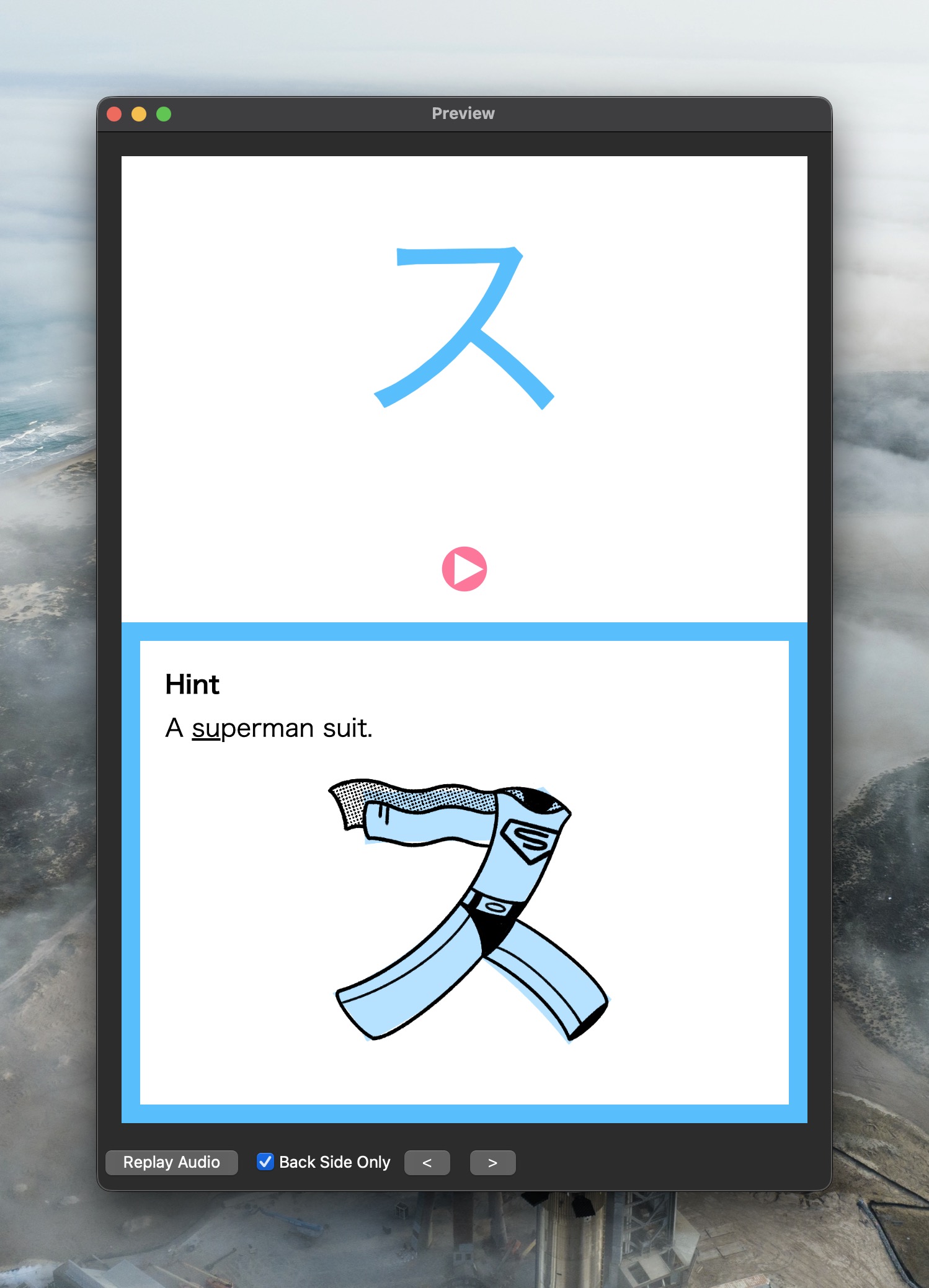
However, I wouldn't recommend learning kanjis. I started but quickly realized that given the time constraint it wasn't a good use of my time. Plus, in Japan, the enjoyment came from being able to interact with people which reading would never have given me either way.
LLMs as a tutor
ChatGPT was essential for me as it helped with the specific vocabulary I needed for my trip. I also bought some books, but ChatGPT was simply a lot better at answering at my level with the exact focus I required.
Again, I took the vocabulary that mattered the most to be and added it to Anki.
ChatGPT's voice mode was also tremendously useful as it can help you test those sentences out loud, get direct feedback, and ask as many questions as you like. I role-played numerous times the situations I thought I would experience to prepare. This turned out to be very valuable.
Premade Anki decks
There are a lot of premade decks for Anki to learn Japanese. I started but quickly gave up as the content wasn't aligned at all with my goals.
Watching Japanese comprehensible input and content mining
There are some great YouTube channels out there dedicated to producing Japanese content that is as easy as possible. Watching some of those videos was a great opportunity to hear the vocabulary I had just learned and get used to hearing Japanese.
I'm also convinced by the idea of creating Anki cards directly from the content you consume (see my sentence mining article) and did that a bit as well. I wish I could have had more time to do it even more.
Creating flashcards in the wild
Once in Japan, you can continue creating flashcards. I would argue it's the best possible moment for that as you can link the card to something you personally experienced which vastly improves the connections made in your brain.
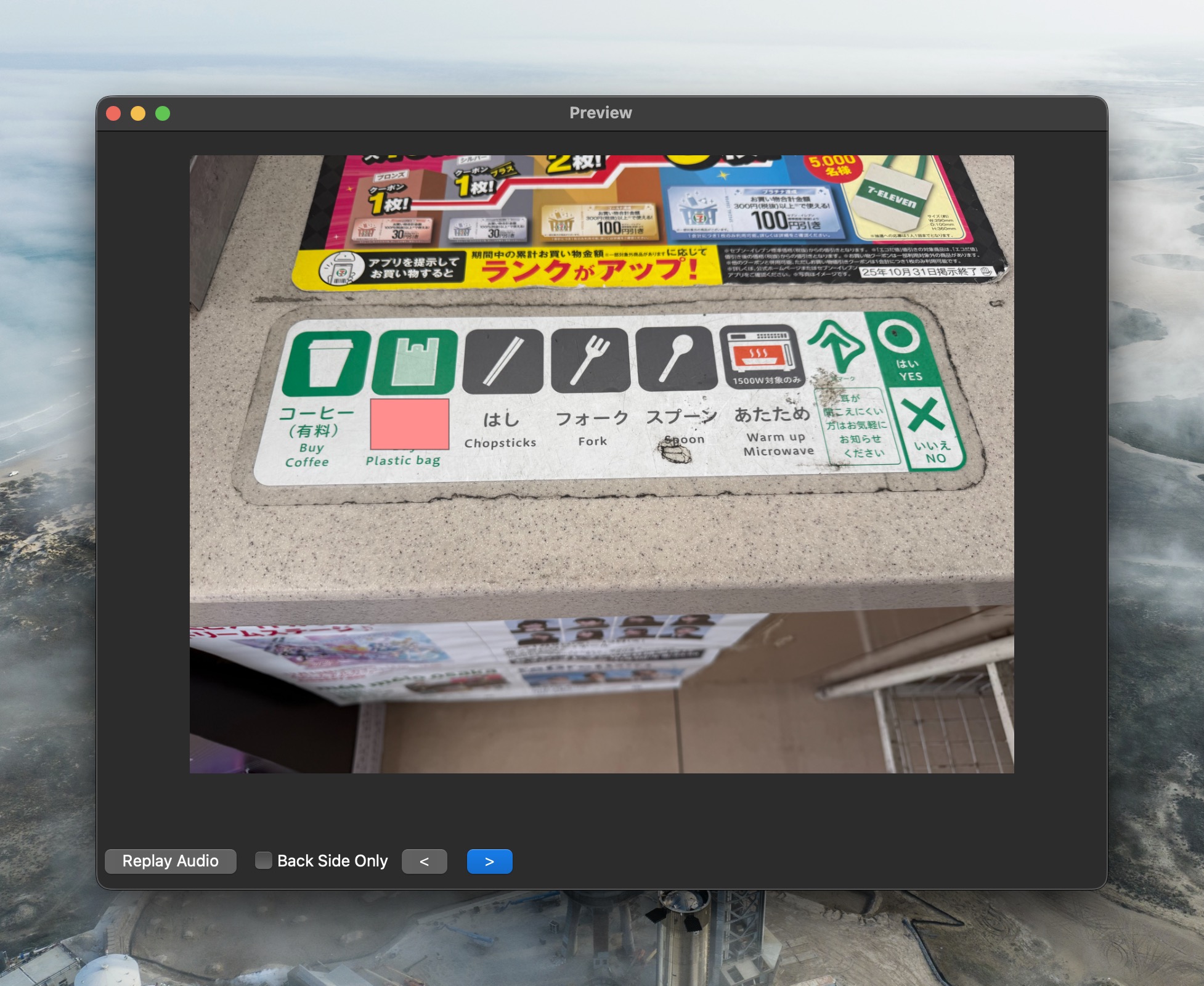
For example, at a convenience store, I needed a plastic bag and noticed the following print. I therefore took a picture and used it as an opportunity to learn how to say the word bag in Japanese. The fact I was in this particular situation and because of the effort made to create this card, I will never forget this word.
For example, at a convenience store, I needed a plastic bag and noticed the following print. I therefore took a picture and used it as an opportunity to learn how to say the word bag in Japanese. The fact I was in this particular situation and because of the effort made to create this card, I will never forget this word.
Conclusion
This time spent learning Japanese was in itself intellectually rewarding but also increased my enjoyment of the trip significantly. I would highly recommend trying it out for yourself if you get the chance!
Comments