One-shotting an incremental reading app in June 2026
TLDR: If you're only curious about the result, check out the video at the end.
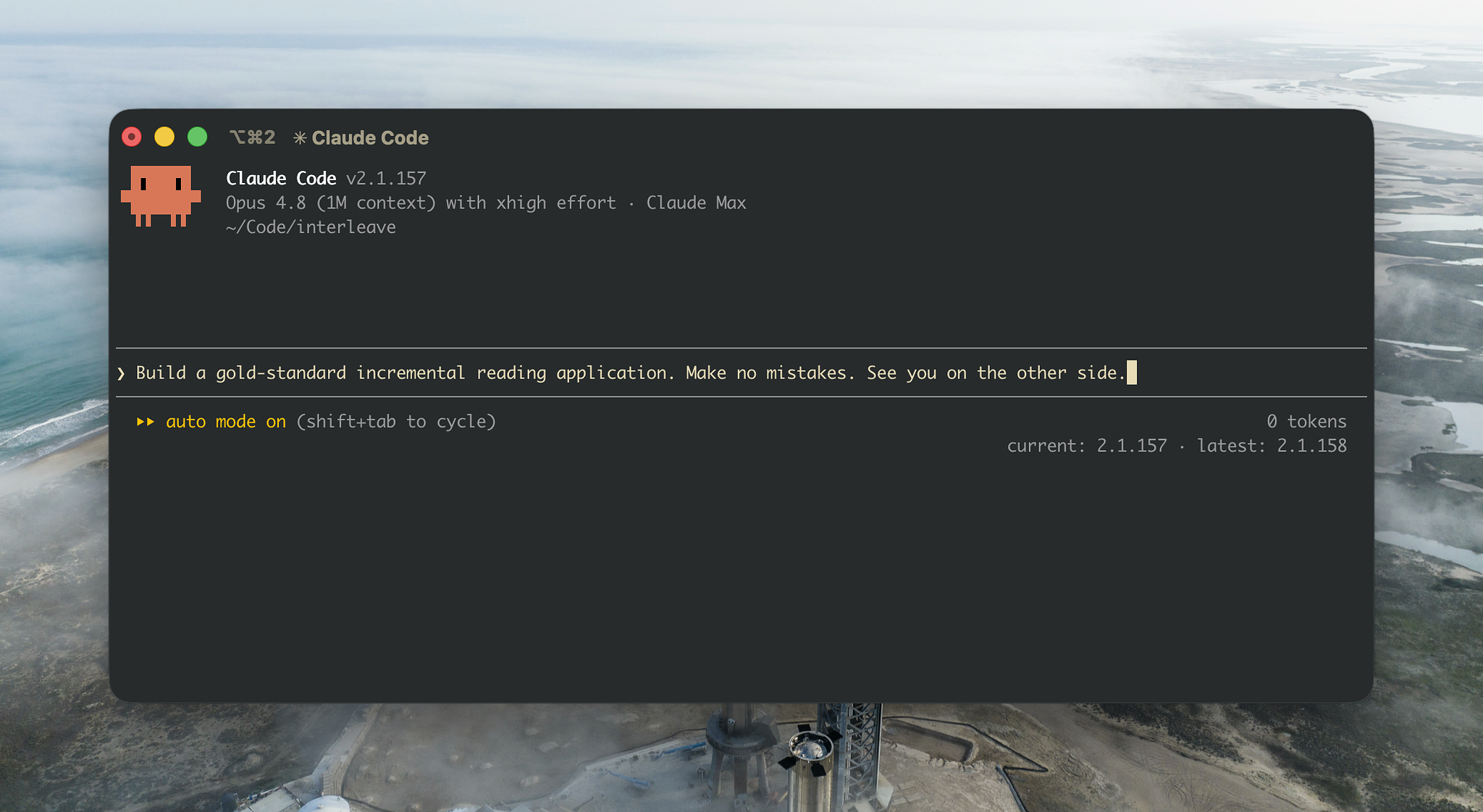
You know what's better than vibe-coding? One-shotting an app. Ideally, it would look something like this:
While this might (hopefully) work in the future, at the moment no LLM can successfully build a complex application... or can they? With the release of Opus 4.8, Claude Code now integrates workflows, which is a way to orchestrate a massive number of agents in one go.
To fully test it out, I tasked it with building an incremental reading application. I wasn't even sure what that was, but I had been curious about the concept for a while and thought it would be a good test. My goal was to give absolutely no direction to the LLM and see what it could do autonomously. Before it started building, I:
Asked GPT 5.5 Pro to research incremental reading, then list all the features an incremental reading application would include, and list 100 development steps to build the application
Asked GPT 5.5 Pro to list all the design elements that would need to be built, including the key main screens, and then provided that prompt to Claude Design
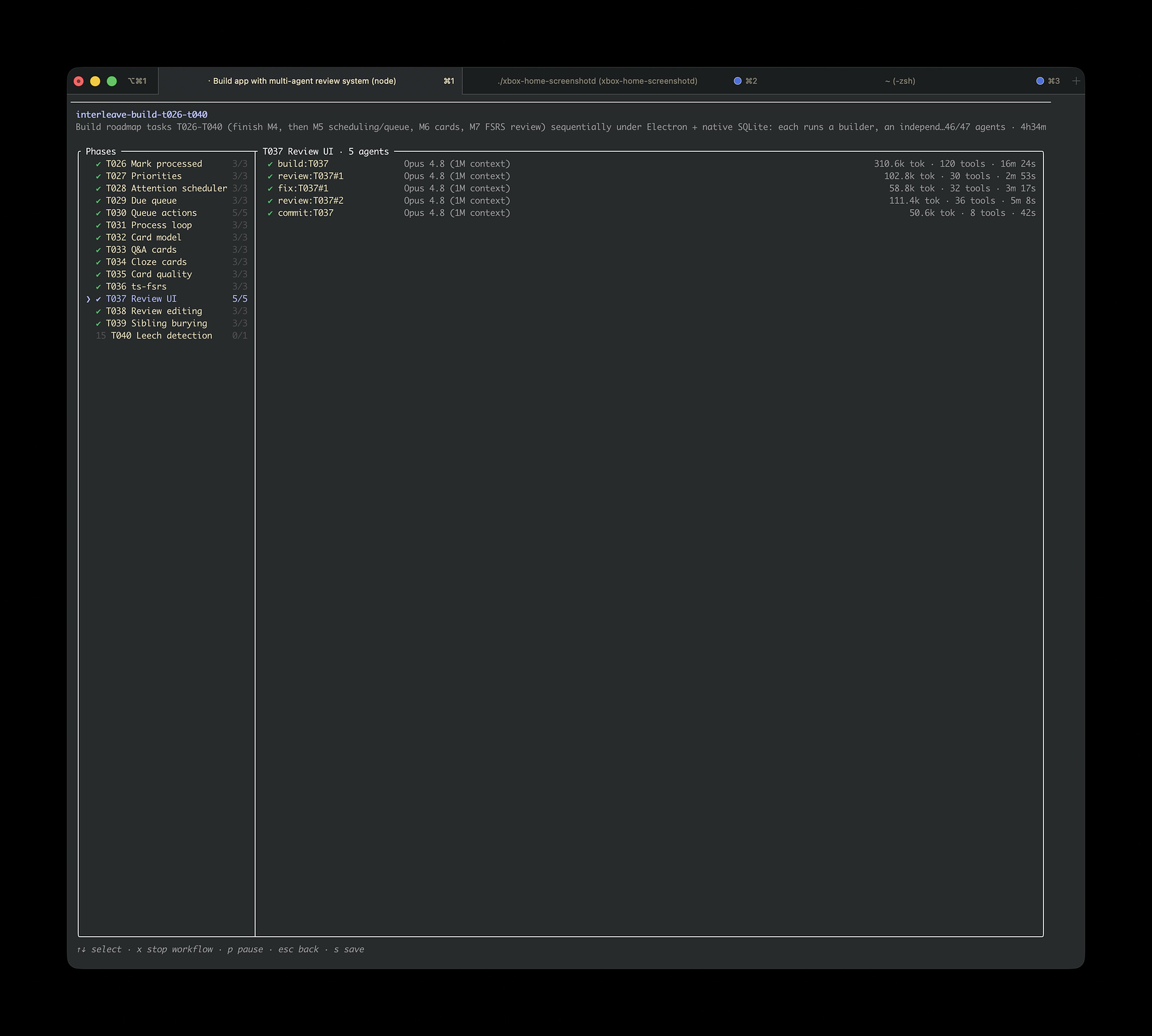
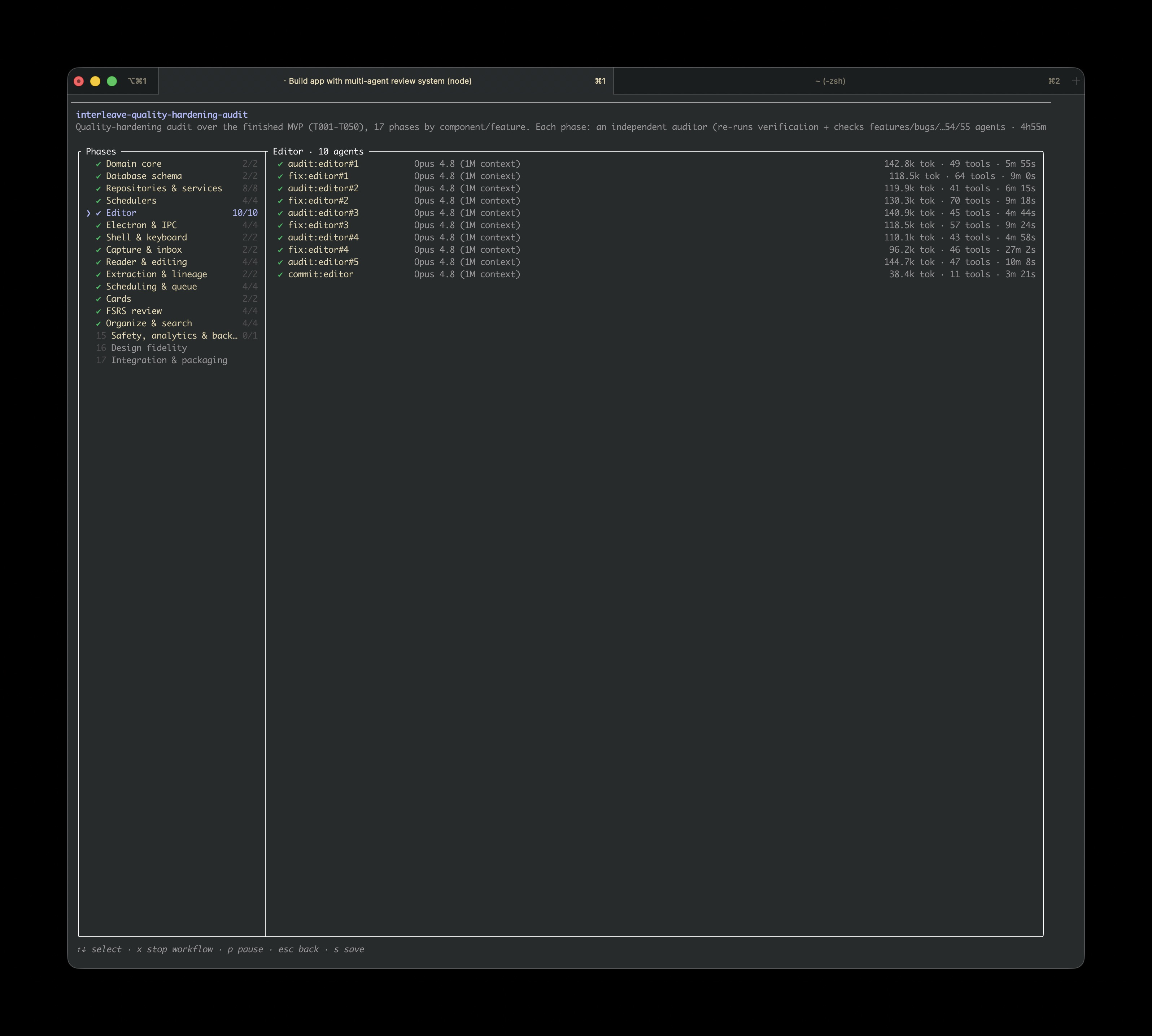
Workflows address the fact that LLMs struggle with maintaining very long sessions that require both deep work and a coherent long-term vision. A partial solution is using agents to avoid bloating the context, but this only works for so long. In this case, I was working through over 50 todos (for the MVP), which required building, reviewing, fixing (sometimes multiple times), and then committing... 50 times in a row. I told Claude to implement a workflow that would fit that goal, and it worked perfectly:
As you can see, every todo is a phase that includes multiple agents. Which agent gets triggered depends on logical steps defined at the creation of the workflow. The advantage of this approach is that the orchestrator doesn't actively do anything while it's running. You set the conditions (including reasons why the flow might break and return to the orchestrator) and wait until it returns.
In this case, it took a little less than 5 hours, with more than 50 agents, without any hiccups!
I then ran another workflow to review the key parts of the application and fix any significant problems found. Again, the workflow ran for 5 hours, this time with around 60 agents.
What Workflows Make Possible
Workflows are finally a powerful and easy solution for orchestrating dozens of agents across many hours. Because I was keeping an eye on its work, I didn't trigger the workflow for everything at once, but I absolutely could have, and I'm sure it would have worked just as well.
The Final Result
Overall, I'm very impressed by the result! It took around 16 hours of running Claude Code and used 46% of my weekly quota (on a Max x20 plan). According to ccusage, it consumed around $1,000 worth of tokens.
Here is a video demonstration (using a seed provided by Claude):
Again, this was basically built entirely by AI; from deciding what needed to be in the application, to the design, and then the implementation. It's not perfect, far from it, but considering the lack of any useful direction from me, I am very impressed by the output. And it will only get better!
3 days later...
Anthropic ended up resetting everyone's weekly quote 2 days before it usually resets so I asked Claude to continue building. It went through the next 50 todos up to release 0.2.0. I feel the outcome is very impressive. They were a couple of bugs especially visual, but I don't see anything major. I actually look forward to giving the application a try!
Comments